Mould Remediation Brisbane & Gold Coast
Professional assessment, containment, removal and prevention of mould — providing Mould Remediation Brisbane and Mould Remediation Gold Coast services aligned with IICRC S520 principles and always addressing the underlying moisture source, so the mould does not simply return.
A Moisture Problem, Not Just A Surface Problem
South East Queensland’s subtropical climate — temperatures typically above 20°C year-round and indoor humidity that regularly exceeds 70% without adequate ventilation — creates near-ideal conditions for mould growth.
Older timber-framed homes, common in suburbs such as Annerley, Greenslopes, Ashgrove and Taringa, are particularly susceptible, as are basements, subfloor cavities and poorly ventilated bathrooms and laundries in Gold Coast apartment buildings.
Mould is almost always symptomatic of a moisture problem — a roof leak, rising damp, condensation, flood inundation or poor ventilation. Mould remediation Brisbane and mould removal Gold Coast should always address the underlying moisture source, because treating the surface without eliminating the cause can lead to recurrence. Our process begins with identifying and resolving the source before mould treatment and prevention.
Our Mould Remediation Process
Assessment & air quality testing
Visual inspection and, where warranted, surface sampling and accredited laboratory air testing to establish the extent, species and appropriate remediation level (I–IV per IICRC S520).
Moisture source identification
We trace and document the moisture pathway using moisture meters, thermal imaging and roof or subfloor inspection. The source must be eliminated before or during remediation.
Containment
For significant contamination we establish physical barriers using polyethylene sheeting and HEPA-filtered negative air pressure, preventing cross-contamination to unaffected areas.
Safe work practices
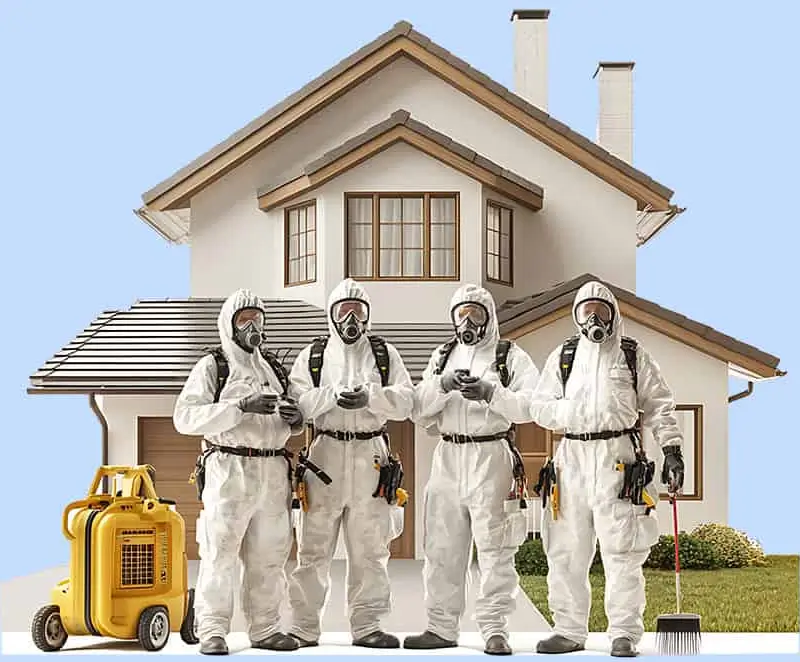
Technicians work in appropriate PPE — respirators, disposable suits and gloves — per Queensland WHS requirements and IICRC S520 protocols.
Mould removal
Non-porous surfaces are cleaned with antimicrobial agents and HEPA vacuuming. Porous materials with significant penetration are removed under a controlled, documented strip-out protocol.
Antimicrobial treatment & encapsulation
Affected areas receive antimicrobial treatment, and registered encapsulant coatings are applied to structural timber where appropriate.
Clearance testing
We recommend a clearance air quality test by an accredited hygienist — documented assurance the remediation was effective, important for claims, sales and strata disputes.
Reinstatement & prevention
Stripped areas are reinstated and, where appropriate, ventilation, vapour barriers or drainage improvements are installed to prevent recurrence.
Remediation That Addresses The Cause
A standard residential remediation — a single room with localised growth — typically takes 1–3 days. Extensive contamination involving structural strip-out and reinstatement can take 1–3 weeks.
- IICRC S520 remediation levels I–IV
- Moisture source traced and eliminated, not just treated
- HEPA-filtered containment for significant contamination
- Laboratory air quality and clearance testing available
- All removed materials photographically documented
- Post-remediation ventilation and prevention recommendations
Common Questions
Mould exposure can cause respiratory irritation and allergic reactions, and certain species (including Stachybotrys, commonly called “black mould”) are associated with more severe impacts under prolonged exposure. We encourage occupants of heavily affected properties to seek medical advice. Our role is to remove the mould safely and address the moisture cause.
Surface mould on non-porous tiles and glass can sometimes be managed with proprietary cleaners. But mould in wall cavities, subfloors, insulation or structural timber requires professional remediation. DIY bleach on porous surfaces addresses appearance only — not deep mycelium growth — and does nothing about the moisture cause.
A standard residential project (single room, localised growth) typically takes 1–3 days. Extensive contamination across multiple areas, or involving structural strip-out and reinstatement, can take 1–3 weeks. We provide a clear programme at the scope stage.
Mould recurs if the moisture source is not eliminated. Our process specifically identifies and addresses the underlying moisture pathway, and we provide post-remediation recommendations for ventilation and maintenance to reduce recurrence risk.
You May Also Need
Musty odours, staining or visible mould?
Book an assessment. We identify the moisture source, remediate safely, and give you documented clearance you can rely on.